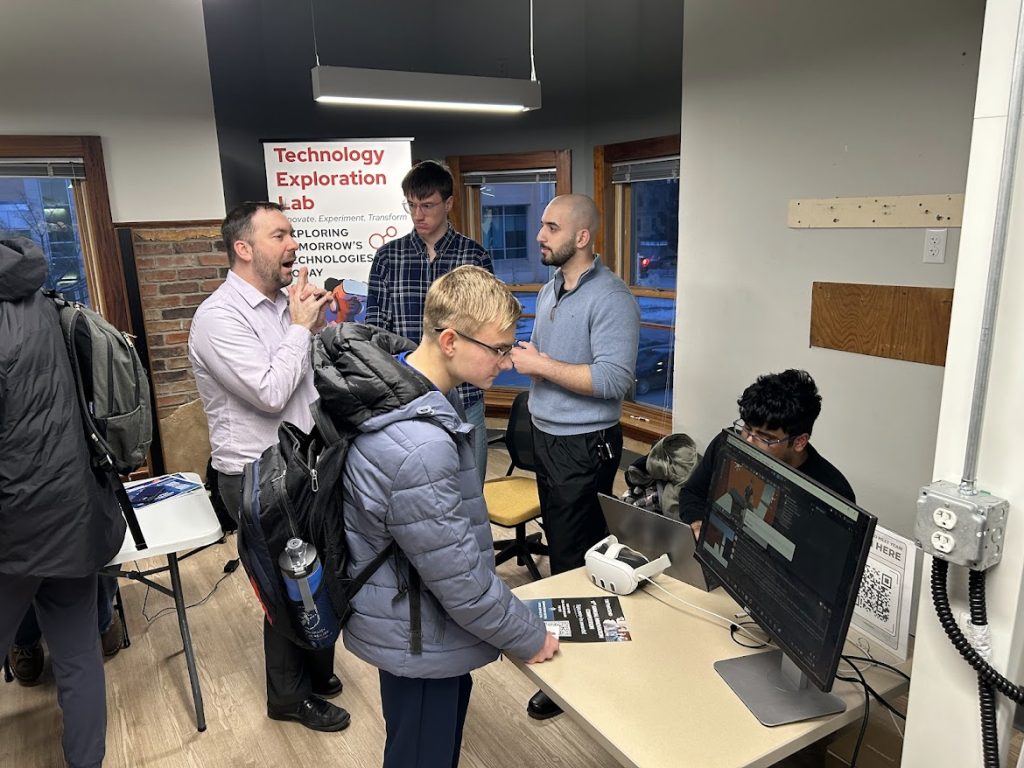
 You see the big problems. We help activate the solutions.
The Tech Exploration Lab connects researchers and faculty with cross-disciplinary student teams ready to tackle hard, meaningful challenges — building early prototypes, assessing market potential, and developing go-to-market strategies using AI and emerging technologies.
We work in two ways: activating student teams around challenges in your domain, and helping translate early-stage research into commercially viable opportunities. Either way, the work is real, the students are builders, and the output is something you can actually use.
Two Ways to Work With Us
Surface a Challenge — Activate a Solution
You know your field. You see the problems that aren’t being solved, the inefficiencies that persist, the gaps that matter. We help you bring those challenges to student teams who will ideate, prototype, and build toward real solutions using AI and emerging technologies.
This is fast, hands-on, and grounded in your domain expertise. We work with you to surface and frame the challenge, then activate students through hackathons, build sprints, and focused project engagements to develop early-stage solutions.
Example — UW School of Veterinary Medicine A Vet Med researcher identified a critical communication gap in the dairy industry: veterinarians and farm workers — many of whom are ESL speakers — struggle to communicate effectively in high-stakes environments. The Lab activated a student team that is now prototyping a real-time AI translation tool designed specifically for veterinary and agricultural contexts. A real-world problem, a practical solution, built by students with the tools to make it work.
Translate Research Into Commercial Opportunity
Have early-stage technology or research with commercial potential that hasn’t been tested against a market yet? The Lab helps you find out whether it can go somewhere — and what it would take to get there.
Student teams help answer the questions that matter most at this stage:
- Is there a real use case here?
- Who would buy this, and why?
- What would an early MVP look like?
- What’s the path to commercial application?
Teams combine technical building capability — prototyping with AI and emerging technologies — with business intelligence, market analysis, and go-to-market strategy. The output is real evidence about your technology’s commercial potential and a clearer sense of next steps.
What You Get
Across both engagement models, researcher and faculty partners get access to:
- Technical students who build early prototypes and MVPs using AI and emerging technologies
- Business students who assess market potential, develop business models, and shape go-to-market strategy
- Structured experimentation designed to generate insight quickly without committing significant internal resources
- Early signal on whether a challenge has a viable solution or a technology has commercial legs
Some Examples of Campus & Research Translation
A growing area of Lab work involves bridging the gap between university research and real-world application — helping faculty and researchers assess the venture potential of promising work and find pathways to bring it to market.
- School of Veterinary Medicine Translation Tool — A real-time AI translation tool improving communication between English-speaking veterinarians and Spanish-speaking dairy farm workers, developed in direct partnership with the UW School of Veterinary Medicine.
- ARHat+ — Built on UW-Madison research, a smartphone-based LiDAR and AR tool that rapidly identifies home safety risks and aging-in-place modifications, streamlining documentation for care professionals and integrating with EHR and insurance systems.
- RAAS (Robotics-as-a-Service) — A commercialization enablement platform that gives university robotics researchers a structured path from lab to market readiness, reducing technical fragmentation and accelerating development timelines.
- AI Research Assistant — An AI model designed to streamline workflows and improve outcomes for academic researchers across synthesis, analysis, and discovery.
- Chatbot for Entrepreneurs — A conversational AI tool helping small business owners and entrepreneurs navigate uncertainty and make more confident planning decisions.
How It Works
Engagements are scoped based on your project’s requirements and stage — from focused hackathons and build sprints to semester-long project engagements. Students commit approximately 8–10 hours per week and are paid through a project stipend or hourly arrangement funded by the researcher or faculty partner.
If you have a challenge worth solving or a technology worth translating, the first step is a conversation.
Contact us to learn more
About the UW Tech Exploration Lab
The Lab is a collaboration between the Wisconsin School of Business and the Wisconsin Institute for Discovery. We activate early-stage innovation and ventures at UW–Madison, connecting students, industry partners, researchers, and alumni around real problems, applied AI, and emerging technologies.