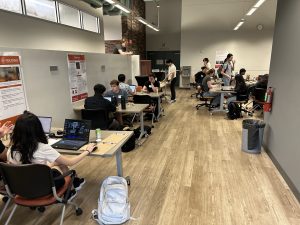
On Saturday, July 18, the UW Tech Exploration Lab hosted its first Spatial Intelligence Ideathon — a one-day student pitch competition built around two real technologies: SGA-AR, a spatially grounded AI framework developed by Professor Kevin Ponto at the Wisconsin Institute for Discovery, and ZaiNar’s RF-based indoor positioning platform.
The energy in the room was exactly what the Lab is built for — students from across campus, working on real problems, thinking like founders.
The Challenge
Students chose one of two tracks. Track 1 challenged teams to find a compelling commercial opportunity for SGA-AR — any domain, any application, with the requirement that the technology be central to the concept. Track 2 challenged teams to build on ZaiNar’s location data platform — a new venture, a verticalized application, an AI interface, or anything that used ZaiNar’s infrastructure as its foundation.
Customer Validation Checkpoint
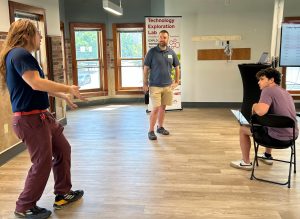
Built into the day at 12:30 PM was a live customer validation simulation. An MBA Lab fellow played the role of a skeptical buyer and gave each team three minutes to pitch their concept and answer pushback — before they spent the afternoon polishing the wrong idea.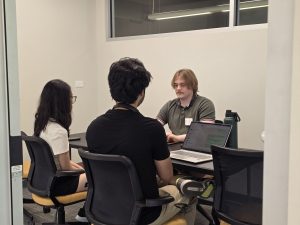
The Winners
Track 1 – Find a Market for SGA-AR
- 🥇 Cairn — A live shared 3D map of data center construction that saves crews hours every week and prevents millions in delay losses
- 🥈 Atlas — Implementing SGA-AR for space exploration
Track 2 – Build on ZaiNar
- 🥇 Reliable Residents — Real-time location intelligence for nursing homes, changing how care teams coordinate around residents
- 🥈 SafeSight and Convoyage tied for second — SafeSight addresses production safety in semiconductor facilities; Convoyage gives airports a live terminal map for passengers with disabilities who get lost between handoffs
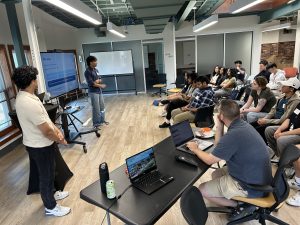
All projects:
Cairn 🥇 — Live shared 3D maps of data center construction. Saves crews hours per week and prevents millions in delay losses.
Atlas 🥈 — SGA-AR for space exploration. Giving distributed crews a shared live map of environments that can’t be navigated the same way twice.
BluClass — An intelligent classroom that understands how students learn and turns every lesson into a shared spatial experience.
Reliable Residents 🥇 — ZaiNar for nursing homes. Real-time location intelligence that changes how care teams coordinate around residents.
SafeSight 🥈 — ZaiNar location data applied to semiconductor production facilities. Flags proximity risks and safety blind spots for production employees in real time.
Convoyage 🥈 — Airports track planes to the second but lose passengers with disabilities between handoffs. Convoyage gives staff a live terminal map and families a real-time link.
WorkSense — Real-time spatial intelligence for safer robot-human collaboration on factory floors.
Zeta — Camera-free predictive movement tracking for patient monitoring. Detects movement patterns and alerts staff before a fall happens.
Industrial Asset Intelligence — A persistent shared knowledge layer for industrial environments. Connects technicians, remote experts, and AI so expertise never retires.
VenueTrace — Live operational intelligence for venues and arenas. Tracks staff, assets, and crowd movement in real time.
What Made This Event Different
This wasn’t a traditional hackathon. Students weren’t building software or polishing pitch decks. They were translating real university research into commercial hypotheses — identifying specific buyers, naming the workaround their concept would replace, and making the case that someone would pay for it.
ZaiNar’s team was available on Slack throughout the day to answer technical questions from teams in real time — exactly the kind of industry engagement that makes a program like this work.
What’s Next
The ideathon was the first step. Several concepts that emerged on Saturday have real commercial legs and the Lab will be following up with those teams. The next phase: build it.